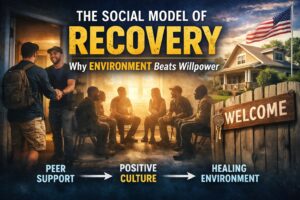
The Social Model of Recovery: Why Environment Beats Willpower
If you’ve ever searched for a sober living home near me, you’ve probably seen the same promises repeated over and over again. Structure. Accountability. Rules. Curfews. Drug testing. These things matter—but they are not the reason people actually recover.
The truth is more uncomfortable and more powerful at the same time.
Most people do not fail in recovery because they lack willpower. They fail because they are in the wrong environment.
That statement challenges how many people think about substance abuse, and it challenges how many programs are designed. But if you look closely at real outcomes—not theory, not intention, but actual results—you start to see a consistent pattern. People become like the environment they live in.
That is the foundation of the social model of recovery, and it is the reason why the right sober living home in Boise can dramatically change the trajectory of someone’s life.
Why Willpower Alone Doesn’t Work
Willpower sounds good. It feels strong. It makes for great motivational speeches. But in the real world, it is unreliable.
If willpower worked the way people think it does, relapse rates wouldn’t be what they are. People would simply decide to stop and then follow through.
But addiction does not operate on logic alone. It operates on emotion, habit, identity, and environment.
A person can wake up in the morning completely committed to staying sober. Then they walk into an environment where people are using, where there is chaos, where there is no structure, where negativity spreads quickly—and within hours, that commitment starts to erode.
This is not a character flaw. It is human nature.
Human behavior is heavily influenced by surroundings. The people you are around, the expectations placed on you, the energy in the environment—these factors shape decisions far more than internal motivation alone.
That is why people can leave treatment highly motivated and still relapse quickly if they return to the same environment that reinforced their addiction.
This is also why a well-run mens sober living home or womens sober living home can create dramatically different outcomes. It is not about forcing people to be better. It is about placing them in an environment where better behavior becomes the default.
The Core Idea of the Social Model of Recovery
The social model of recovery is built on a simple but powerful concept: recovery is not just an individual process, it is a social process.
People do not recover in isolation. They recover in community.
This model recognizes that behavior is shaped by three primary forces. First, social norms—people tend to do what the group around them is doing. Second, emotional contagion—energy spreads quickly, whether it is positive or negative. Third, identity—people begin to see themselves differently based on who they are surrounded by.
When these forces are aligned in the right direction, recovery becomes much more sustainable. When they are not, even the most motivated individual struggles.
A strong sober living home in Boise that operates under the social model intentionally builds an environment where these forces work in favor of recovery instead of against it.
Environment Shapes Behavior More Than You Think
Think about how quickly people adapt to new environments in everyday life. A person who moves into a high-performing workplace often becomes more productive. A person who joins a group that prioritizes health often starts exercising more and eating better.
The same principle applies to recovery.
In a high-quality womens recovery home or mens sober living home, the expectations are clear. People attend meetings. People engage with each other. People hold each other accountable. There is a shared standard.
Over time, new residents begin to adopt those behaviors—not because they are forced to, but because it is what the environment reinforces.
This is where most people misunderstand recovery. They believe change starts internally and then shows up externally. In reality, the process often works in reverse. Change starts externally, through environment and behavior, and then reshapes internal identity.
Someone who consistently shows up, engages, and participates begins to see themselves differently. They stop identifying as someone who is trying to get sober and start identifying as someone who is sober.
That shift is everything.
The First 24 Hours Matter More Than Most People Realize
When someone enters a sober living home near me, especially after treatment or a difficult period, they are often in a fragile state. They are uncertain, anxious, and trying to figure out whether they made the right decision.
This is where environment makes an immediate impact.
In a poorly run house, a new resident might walk in and feel disconnected. No one greets them. No one engages them. The process feels cold and transactional. That feeling can create distance from the group before they even have a chance to integrate.
In a well-run sober living home Boise, the experience is completely different. There is a sense of welcome. There is connection. There is intentional effort to make the new resident feel safe and respected.
That initial experience sets the tone. It determines whether the person leans into the environment or withdraws from it.
The social model recognizes that these moments are not small details. They are critical leverage points.
Peer Leadership vs. Staff Control
One of the defining features of the social model is the emphasis on peer leadership rather than relying solely on staff.
In many traditional models, staff enforce rules and residents comply. This creates a top-down dynamic that can feel external and temporary.
In contrast, a strong mens sober living home or womens sober living home operating under the social model develops leadership within the house itself. Residents take ownership of the environment. They model behavior. They influence culture.
This creates a much more powerful system.
When expectations come from peers rather than authority figures, they are often more impactful. People are more likely to respond to someone who is walking the same path and demonstrating what success looks like in real time.
It also builds responsibility. Instead of being passive participants, residents become active contributors to the environment.
That shift from consumer to contributor is a major factor in long-term success.
Culture Is the Real Standard
Many sober living homes rely heavily on rules to maintain order. Rules are necessary, but they are not sufficient.
Culture is what determines whether those rules are actually lived out.
In a strong environment, the culture supports recovery. People want to do the right thing. They hold each other accountable. They take pride in the house. There is a sense of shared purpose.
In a weak environment, rules exist on paper but are not enforced socially. People cut corners. Standards slip. Accountability is inconsistent.
The difference is not the rulebook. The difference is the culture.
This is why the best sober living homes focus heavily on building and maintaining culture. It is also why the phrase “best sober living home in Boise” should not just refer to amenities or location, but to the quality of the environment and the strength of the culture inside the house.
Why Some People Thrive and Others Don’t
Even within the same sober living home Boise, outcomes can vary. Some people thrive. Others struggle.
The social model helps explain why.
The individuals who thrive tend to engage with the environment. They build connections. They participate in the culture. They align with the expectations of the house.
Those who struggle often remain on the outside. They resist the environment. They isolate. They maintain distance from the group.
The difference is not intelligence or potential. It is alignment with the environment.
This is why choosing the right sober living home near me is critical. Not every environment is the same. Some are passive. Some are chaotic. Some are intentional and structured.
The environment you choose will either support your recovery or make it significantly harder.
The Role of Accountability
Accountability is often misunderstood. It is not about punishment. It is about alignment.
In a strong womens sober living home or mens sober living home, accountability is consistent and expected. It is part of the culture.
Residents hold each other accountable not to control behavior, but to protect the environment.
This creates a system where standards are maintained without constant oversight from staff. It also reinforces the idea that everyone plays a role in the success of the house.
Accountability, when done correctly, strengthens relationships rather than damaging them. It builds trust. It creates clarity. It ensures that the environment remains supportive for everyone.
Why Environment Beats Willpower Every Time
At the end of the day, the reason environment beats willpower is simple.
Willpower fluctuates. Environment is constant.
A person can have a strong day or a weak day. Their motivation can rise and fall. But if they are in an environment that consistently reinforces positive behavior, they are much more likely to stay aligned.
Conversely, even a highly motivated person will struggle in an environment that undermines their goals.
This is not a matter of opinion. It is observable reality across countless situations.
The social model of recovery does not ignore personal responsibility. It enhances it by placing individuals in a context where making the right choice is easier and more natural.
Choosing the Right Sober Living Home
If you are searching for a sober living home near me, especially in Boise, it is worth looking beyond surface-level features.
Ask deeper questions.
What is the culture like?
How do residents interact with each other?
Is there strong peer leadership?
Is the environment intentional or passive?
Do people feel connected or isolated?
These factors will have a far greater impact on outcomes than amenities or convenience.
A high-quality sober living home in Boise that operates under the social model will feel different. There will be energy. There will be engagement. There will be a clear standard.
That is not accidental. It is designed.
Final Thought
Recovery is not just about stopping a behavior. It is about becoming a different person.
And people do not become different in isolation. They become different through the environments they are part of.
The social model of recovery recognizes this and builds systems that leverage it.
If you are serious about overcoming substance abuse, do not just focus on willpower. Focus on environment.
Because in the long run, environment wins every time.
For further reading on the principles behind the social model of recovery and how environment impacts behavior, you can explore resources from the National Institute on Drug Abuse and the Substance Abuse and Mental Health Services Administration, both of which provide extensive research and guidance on effective recovery approaches.