Why Length of Stay Is One of the Strongest Indicators of a Successful Sober Living Program
What Our Data at Phoenix House Sober Living Reveals About Real Recovery
When individuals and families search for a sober living home, they are often forced to rely on surface-level indicators: testimonials, photos, promises of structure, or claims of success. While those elements matter, they rarely tell the full story.
At Phoenix House Sober Living in Boise, we believe there is a more honest, measurable, and revealing metric of program quality:
Length of stay.
Length of stay is not marketing language. It is behavior. People vote with their feet. They stay where they feel safe, supported, and able to grow — and they leave environments that are chaotic, unclear, or ineffective.
Our length-of-stay data tells a clear story about what happens inside our sober living homes for men and women recovering from substance abuse and alcohol dependence. It reflects stability, accountability, and an environment where recovery can take root over time.
What Length of Stay Means in Sober Living
Length of stay refers to the amount of time a resident remains actively engaged in a sober living program before transitioning to independent housing or another appropriate next step.
In recovery from substances and alcohol, time is not optional. Recovery is not a single decision or a short intervention. It is a process of rebuilding daily life:
-
Learning to regulate emotions without substances
-
Establishing routines and responsibility
-
Maintaining employment or vocational progress
-
Rebuilding trust with family and community
-
Practicing accountability consistently
Sober living homes exist to provide the structure and environment necessary for that process. When residents leave too quickly, it often indicates unresolved instability rather than success.
Why Short Stays Are Common — and Concerning — in Sober Living
Across the sober living industry, many homes experience rapid turnover. Residents enter motivated, but leave within weeks or a few months due to:
-
Inconsistent rule enforcement
-
Lack of structure or supervision
-
Unsafe peer environments
-
Financial instability
-
Relapse without adequate intervention
Short stays are not always a failure of the individual. More often, they signal a program that lacks the systems required to support people through the most difficult phases of early recovery.
When a sober living home consistently retains residents beyond the early weeks and months, it suggests something fundamentally different is happening.
Research Supports Longer Engagement in Recovery Housing
Substantial research confirms what lived experience has long shown: longer engagement in recovery-oriented environments produces better outcomes.
The National Institute on Drug Abuse (NIDA) emphasizes that sustained participation in treatment and recovery supports significantly reduces relapse risk and improves long-term recovery outcomes. Recovery is most effective when support extends well beyond initial detox or treatment phases.
👉 Authoritative source:
https://nida.nih.gov/research-topics/treatment
Similarly, the Substance Abuse and Mental Health Services Administration (SAMHSA) identifies recovery housing as a critical long-term support, not a short-term solution. Stable housing paired with accountability improves employment, health, and sobriety outcomes.
👉 Authoritative source:
https://www.samhsa.gov/recovery/housing
Time matters. Environment matters. Structure matters.
Phoenix House Length of Stay: What Our Data Shows
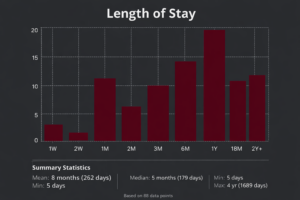
Phoenix House tracks resident length of stay across our sober living homes to maintain transparency and accountability. Our current dataset includes 88 residents, which provides a meaningful and reliable sample.
Summary Statistics
-
Average (Mean) Length of Stay: 8 months (262 days)
-
Median Length of Stay: 5 months (179 days)
-
Shortest Stay: 5 days
-
Longest Stay: Over 4 years (1,689 days)
Distribution Patterns
-
Very few residents leave in the first one to two weeks
-
A strong concentration remain 3 months, 6 months, and 1 year or longer
-
A significant number stay 18 months, 2 years, and beyond
This pattern is not typical within sober living environments. In many programs, retention declines sharply after the first 30–60 days. At Phoenix House, retention strengthens over time.
Why the Median Length of Stay Matters More Than the Average
The median length of stay — 5 months — is particularly important.
The median tells us that half of all residents stay at least five months or longer. This means extended engagement is normal at Phoenix House, not exceptional.
While averages can be skewed by a few very long stays, the median reflects the typical resident experience. In the sober living industry, remaining engaged for five months represents a substantial commitment to recovery.
At Phoenix House, three months is not considered “long-term.” It is considered the foundation.
What Strong Length of Stay Reveals About Our Program
1. A Safe and Predictable Environment
People do not remain in environments where they feel unsafe, disrespected, or uncertain.
Long lengths of stay strongly suggest that residents experience:
-
Physical safety
-
Emotional stability
-
Clear boundaries
-
Consistent rule enforcement
Safety is the prerequisite for recovery. Without it, residents remain in survival mode. Our data indicates that residents find Phoenix House to be a place where they can focus on growth rather than chaos.
2. Structure That Supports Recovery From Substance Abuse
Recovery from alcohol and other substances requires consistent structure, especially in early stages.
Phoenix House emphasizes:
-
Clear daily expectations
-
Employment or vocational engagement
-
Random drug and alcohol testing
-
Chores and shared responsibility
-
Peer accountability
Structure is not punishment. It is the scaffolding that allows residents to rebuild habits, identity, and confidence. Longer stays indicate that residents are benefiting from this structure rather than resisting it.
3. A Peer Culture That Encourages Growth
Peer culture is one of the most underestimated factors in sober living success.
In unstable homes:
-
Residents cycle in and out rapidly
-
New residents are surrounded by instability
-
Peer influence increases relapse risk
In healthy homes:
-
Longer-term residents model stability
-
Leadership emerges organically
-
New residents see tangible proof that recovery is possible
Our length-of-stay distribution shows a strong retention curve after three and six months. This suggests that peer culture at Phoenix House reinforces growth rather than undermining it.
What Length of Stay Means for Men in Recovery
Men recovering from substance abuse often face compounded challenges, including:
-
Criminal justice involvement
-
Employment gaps
-
Damaged family relationships
-
Loss of identity and purpose
A sober living home for men must provide more than housing. It must provide:
-
Clear expectations
-
Accountability tied to action
-
Opportunities for leadership
-
Time to rebuild confidence
Longer stays allow men to move beyond crisis management and begin rebuilding identity. Employment stability, financial responsibility, and healthy relationships develop over months, not weeks.
What Length of Stay Means for Women in Recovery
Women in recovery often carry additional burdens, including trauma histories, caregiving responsibilities, and social stigma.
A sober living home for women must prioritize:
-
Emotional safety
-
Respectful boundaries
-
Predictability
-
Time to heal
Extended length of stay suggests that women feel safe enough to remain and continue growing rather than being forced out prematurely by instability or conflict.
Length of Stay and Long-Term Recovery Outcomes
Extended engagement in sober living is strongly associated with:
-
Higher employment rates
-
Lower relapse rates
-
Reduced criminal justice involvement
-
Improved family relationships
-
Increased self-efficacy
Recovery from substances and alcohol is not simply about abstinence. It is about learning how to live responsibly, consistently, and with purpose.
Our data shows that Phoenix House provides an environment where residents remain long enough for these changes to occur.
Why Phoenix House Tracks and Shares This Data
Transparency matters.
Families, referral partners, and residents deserve more than promises. They deserve evidence.
Length of stay is difficult to manipulate at scale. It reflects:
-
Program leadership
-
Consistency of expectations
-
Safety of the environment
-
Effectiveness of structure
We track this data to hold ourselves accountable and to provide a clear picture of what life is actually like inside our sober living homes.
How to Evaluate a Sober Living Home Using Length of Stay
When evaluating a sober living home, consider asking:
-
How long do residents typically stay?
-
What percentage remain beyond 90 days?
-
What happens when residents struggle?
-
Is structure consistent or reactive?
Length of stay reveals what marketing cannot.
Length of Stay as a Signal of Program Integrity and Leadership
One additional reason length of stay matters — and one that is often overlooked — is what it reveals about program integrity and leadership quality.
In sober living, leadership shows up not in marketing language, but in day-to-day consistency. Residents quickly learn whether rules are enforced fairly, whether expectations are clear, and whether leadership is present or reactive. Programs that rely on charisma, threats, or constant crisis management tend to experience rapid turnover. People may enter hopeful, but they leave once instability becomes clear.
By contrast, longer resident stays strongly suggest that leadership is:
-
Consistent rather than arbitrary
-
Predictable rather than emotional
-
Firm without being punitive
-
Supportive without being permissive
At Phoenix House, length of stay reflects an environment where expectations do not change depending on who is watching, who is struggling, or who is favored. That consistency allows residents to relax into the process of recovery instead of constantly scanning for unfairness or chaos.
Financial Stability and Length of Stay
Another important factor tied directly to length of stay is financial stabilization, which is a critical component of recovery from substances and alcohol.
Early recovery is often marked by:
-
Debt
-
Unstable employment
-
Poor money management habits
-
Legal and financial pressure
A sober living home that focuses only on abstinence, without addressing financial responsibility, unintentionally sets residents up for failure. Short stays often reflect residents who are financially overwhelmed and unable to sustain housing.
Longer lengths of stay, on the other hand, allow residents the time needed to:
-
Secure and maintain employment
-
Catch up on court obligations and fines
-
Begin saving money
-
Practice budgeting and financial accountability
Our data suggests that residents are not only staying sober, but staying long enough to stabilize their lives economically, which is a key predictor of long-term recovery success.
Length of Stay and Family Reconnection
Recovery from substance abuse and alcohol dependence does not occur in isolation. Families are often deeply affected, and rebuilding trust takes time.
Short-term sobriety rarely repairs long-term damage. Families want to see:
-
Consistency over months, not weeks
-
Follow-through on commitments
-
Improved emotional regulation
-
Financial responsibility
Longer lengths of stay create the conditions where residents can demonstrate sustained change rather than short-lived improvement. For many residents at Phoenix House, extended time in sober living allows family relationships to slowly heal, communication to improve, and boundaries to be re-established in a healthy way.
This process cannot be rushed — and length of stay reflects the patience and structure required to support it.
Why Length of Stay Protects the Recovery Environment
Finally, longer resident stays help protect the sober living environment itself.
High turnover introduces instability. Constantly cycling new residents increases the likelihood of:
-
Rule violations
-
Peer conflict
-
Relapse exposure
-
Emotional volatility
When a core group of residents remains over time, it creates:
-
Cultural continuity
-
Peer accountability
-
Informal mentorship
-
Lower overall risk
This is one reason our data shows retention strengthening after the three- and six-month marks. Residents who stay help stabilize the environment for those who come after them, creating a reinforcing cycle of recovery.
The Bottom Line
Our length-of-stay data tells a clear story: people stay at Phoenix House because the environment supports real recovery.
Recovery takes time.
Stability takes structure.
A new life takes commitment.
At Phoenix House, residents are staying — long enough for real change to take root.